The latest work from Associate Professor Carson Fox was featured at the Linda Warren Projects in Chicago.
The term mimesis comes from the Greek word 鈥渕imeisthai鈥� and was used by Plato when describing the role of artists. It means 鈥渋mitation鈥� and the imitation of nature recently took up residence as the title of the latest solo exhibition by Carson Fox, associate professor in the 果酱视频 .
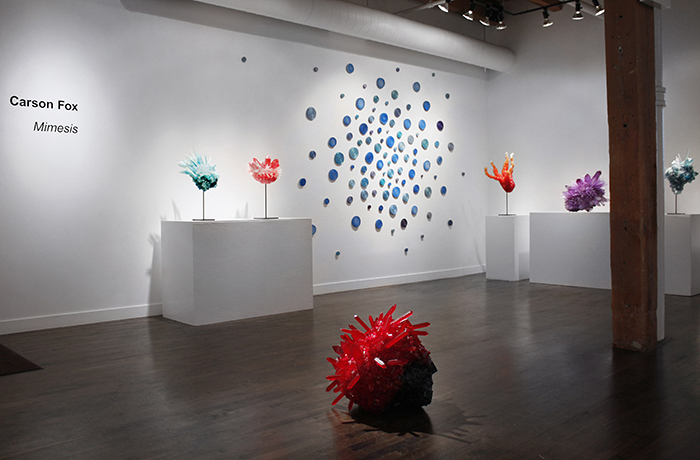
Held at the art gallery in Chicago from October 24鈥揇ecember 13, 2014, Mimesis aimed to capture the passage of history via works based on nature鈥檚 timepieces鈥攏amely, rocks, coral and trees. The exhibition marked the first time these separate collections received a dedicated exhibition en masse.
Fantastical rocks and minerals; coral coursing and reaching across the walls randomly while building on its greater structure; log piles, acorns and tree cross sections on a wall arranged into an explosive array of frozen arbores. It鈥檚 a representation of nature that translates into a powerful experience. It鈥檚 also a small glimpse into the world of an 果酱视频 professor who has an interest in time, and how it can be preserved.
鈥淎s a kid, I had a rock collection,鈥� Fox said. 鈥淸It] received a lot of contemplation. 鈥 was so fascinated with the idea that you could polish rocks and end up with these gorgeous things鈥攖hat underneath that surface was all of this other information that was really beautiful, just waiting to be discovered.鈥�
Now she can create it, adding and subtracting as she sees fit while paying homage to the works of art Earth creates on a daily basis. It鈥檚 like the ultimate extension of her own childhood fantasies, she explained.
Made of resin and hypnotic to look at, each completed mineral piece melds crystalline and geodic qualities that together represent colors of neon and rainbow side by side, a combination that is rarely found in nature.
鈥淚鈥檓 never very dogmatic or true to the actual thing. I just use it as a springboard to create my own [work],鈥� Fox said. 鈥淵ou can鈥檛 make up anything crazier that nature isn鈥檛 already doing.鈥� This approach has allowed her to exercise her artistic license yet still remain true to her exhibition鈥檚 theme of mimicry.
Fox noted that the coral work within the exhibition was closely linked to her mineral and rock creations because the forms were similar.
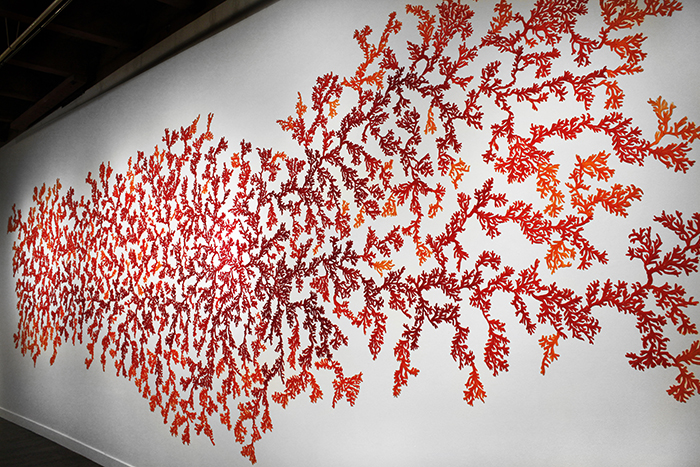
鈥淚 was interested in the idea of nature, where you can create a rhythm of the form itself, and then repeat that endlessly to create something that suggests the natural form,鈥� she said. 鈥淏ecause I could cut the pieces and reconfigure them鈥 [could] create any sort of composition that I wanted.鈥�
It鈥檚 a technique that takes time, but that鈥檚 the point. As Fox noted, 鈥淏ecause coral reefs are built over hundreds, sometimes thousands, of years, I see them as a material in nature that is keeping time.鈥�
With the exception of her rock and mineral pieces, much of the labor involving her coral and arboreal art consists of installation work, meaning the displays must be created anew for each exhibition. Although other artists may recoil at the idea, Fox relishes the concept of creating different works of art via the same piece.
鈥淚鈥檓 very interested in modular things that can be put together in all sorts of different ways to create different artworks,鈥� she said.
The work is never truly done, but neither is nature. It鈥檚 always building, reworking, destroying and rebuilding anew.
鈥淚n a way, there is no end,鈥� Fox said. 鈥淲hen you install this stuff, every time you install it, it鈥檚 different, so the piece is never really fixed. It鈥檚 never really finished. I like that open-endedness. It keeps it alive.鈥�
Her next exhibition, Natural Allusions, will be viewable at in Washington, D.C., beginning January 30 and continuing until March 13, 2015.
For further information, please contact:
Todd Wilson
Strategic Communications Director听
p 鈥� 516.237.8634
e 鈥� twilson@adelphi.edu