Anthropology and Sociology Professor Douglas London, Ph.D., discovers the key to a healthier life.
By Charity Shumway
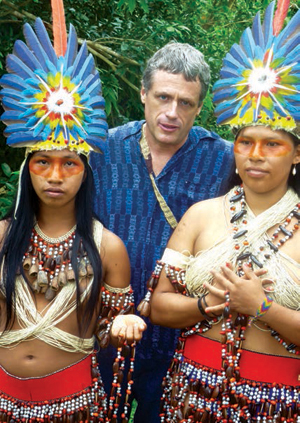 |
| 果酱视频 Assistant Professor Douglas London, Ph.D., with Waorani hunter-gatherer tribal members on the Yasuni River in Amazonian Ecuador |
Imagine you are traveling up a tributary to the Amazon in a canoe. A spear comes flying at you from the jungle along the banks. It hits you, skewering your shoulder or passing through your side. Let鈥檚 say you survive the initial injury. That, of course, isn鈥檛 the end of your worries. Your next concern: infection.
But not if you are a member of the Waorani tribe, a group of hunter-gatherers living in a remote region of Ecuador. 鈥淭hey don鈥檛 get infected, which people would say is impossible,鈥� says medical anthropologist and 果酱视频 Assistant Professor Douglas London, Ph.D., who has spent the last four years studying the Waorani鈥檚 health and diet. 鈥淏asically, Waorani, when they get wounded, the spear goes in one side, comes out the other, they chop the two ends of the spear off, the spear stays there for a while, and it eventually falls out. Never gets infected. Never gets swollen. Nothing happens to them. If it was us, we鈥檇 get a staph infection.鈥�
This is far from the end of the wonders of Waorani health. Dr. London鈥檚 observations and medical tests鈥攖aken over a year while living with the Waorani鈥攕howed that they have almost no chronic diseases and no infectious diseases (other than the few introduced by outsiders). Their eyesight doesn鈥檛 deteriorate over time. And, notably, their body temperature is consistently 1.35 degrees (Farenheit) lower than the range of human body temperature we think of as normal. What explains all this?
Diet is Destiny
Along with the Waorani, Dr. London also studied a neighboring tribe of Quichua, who are subsistence farmers, to compare the two groups. 鈥淵ou have the same environment, the same microbes, but one group doesn鈥檛 get sick and the other group does,鈥� Dr. London says. 鈥淭he only big difference is diet.鈥�
In particular, Dr. London believes, the answer is the phytochemicals in the food the Waorani eat. Phytochemicals, or plant chemicals that are used in self-defense by flora, and that often have medicinal and pharmaceutical properties, are the other side of food,鈥� says Dr. London. 鈥淎t least 10 percent of the dry weight of many plant foods we eat is made up of phytochemicals,鈥� he continues. 鈥淏ecause there are so many varieties of them, it can be overwhelming, so most of the time we focus on a small number of nutrients, which gives a distorted idea of what food is.鈥�
Phytochemicals are the reason many modern medicines work, explains Dr. London. 鈥淲e have receptors in our bodies that are designed to take in plant chemicals,鈥� he says. 鈥淢odern pharmaceuticals use the receptors that originally evolved for phytochemicals. Without those receptors, many drugs would just pass right through us.鈥�
The secret to the Waorani鈥檚 health, Dr. London鈥檚 research shows, is eating wild foods, mostly fruit and meat more typical of the way humanity ate prior to the advent of agriculture, which provide them with a balance of phytochemicals.
Dr. London spent a full year cataloging the entire food systems of both the Waorani group and the Quichua group, photographing and documenting all the foods they consumed. 鈥淭he Waorani have a huge variety of fruits, maybe 80 different fruits that they eat,鈥� Dr. London says. 鈥淎nd they鈥檙e seasonally rotated, so they鈥檙e getting their phytochemicals, but they鈥檙e not getting overwhelmed by eating the same one day in and day out. They鈥檙e constantly changing.鈥�
In addition to fruit, the Waorani eat large amounts of meat. 鈥淭hey eat a pound, a pound and a half, of meat a day,鈥� says Dr. London. 鈥淵ou鈥檙e supposed to get protein poisoning, it鈥檚 supposed to be impossible to eat that much, but that鈥檚 what they do.鈥� Just as the fruit has medicinal benefits for the Waorani鈥檚 health, so, too, does the meat. 鈥淏ecause the animals eat the same plants, they become a source of phytochemicals as well,鈥� explains Dr. London.
The neighboring Quichua tribe eats typical agricultural crops, including vegetables. In contrast, says Dr. London, the Waorani eat no vegetables. 鈥淚n fact, when you give a Waorani a vegetable, they get nauseous; they鈥檒l vomit,鈥� he says. The reason, he explains, is toxic phytochemicals in vegetables. 鈥淔ruits evolved with beneficial phytochemicals听to entice humans and other animals to eat them,鈥� says Dr. London, 鈥渂ut leaves and stalks developed toxic phytochemicals to protect themselves from being eaten.
鈥淭he Waorani have a sensitivity to the smell and taste of phytochemicals that we鈥檝e lost,鈥� Dr. London continues. 鈥淲e can tell a little bit when something is bitter, but the Waorani have a vocabulary for bitter that far exceeds ours. We have maybe one word. They have maybe twenty.鈥�
Braving Snakes to Study Isolated Hunter-Gatherers
Prior to Dr. London鈥檚 research, it is believed, the Waorani tribe and their diet had never been studied. Part of the reason for this is their remoteness. 鈥淭he Waorani live in an unmarked region of Ecuador, and very few people even know they exist,鈥� Dr. London says. Another factor in their isolation is their hostility toward outsiders. 鈥淭hey鈥檙e still a warrior group,鈥� explains Dr. London. In fact, this is one reason the distinctions between the diets of the Waorani and the neighboring Quichua were so clear. 鈥淭he Quichua are afraid of the Waorani, and so the two groups do not mix,鈥� Dr. London says.
Just as in our imagined scenario, Dr. London arrived in a canoe on the banks of the Waorani鈥檚 river. Alarmingly, but not unexpectedly, the threatening spears were far from imaginary. Fortunately for Dr. London, the son of the chief had had some contact with outsiders, and after hours of waiting and negotiating, Dr. London was allowed to safely join the Waorani on land. Initially, he was allowed to spend only a few days, but after several years of repeated contact, Dr. London was invited to stay. He spent a full year camping with the Waorani, braving insects and poisonous snakes. He plans to return this summer to continue his research. 鈥淚t was a little risky,鈥� Dr. London says modestly, 鈥渂ut if you want to find one of the few hunter-gatherer groups that are left, you have to go to very, very isolated places.鈥�
For further information, please contact:
Todd Wilson
Strategic Communications Director听
p 鈥� 516.237.8634
e 鈥� twilson@adelphi.edu