Andreas Karpf, Ph.D. hosted a presentation on New Horizons' mission to Pluto before hosting Observatory Night.
by Dan Rossi 鈥�16
Most people over the age of 18 grew up learning that Pluto was the ninth planet in our solar system. Then many hearts were broken when little Pluto was stripped of its status as a planet in 2006. It has had some rocky times in recent history, and Andreas Karpf, Ph.D., research coordinator for the , sought to answer some of the 果酱视频 community members鈥� lingering questions.
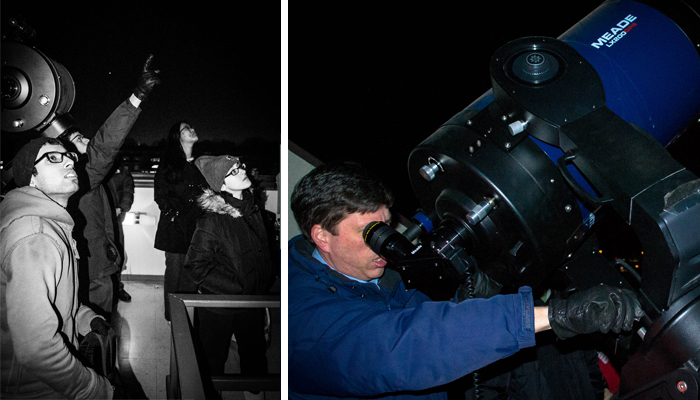
Before taking the attendees to 果酱视频鈥檚 high-end 14-inch for Observatory Night, Dr. Karpf talked about current discussions surrounding Pluto and showed off some of the incredible new photos of its surface. 鈥淚t鈥檚 actually another category of object,鈥� Dr. Karpf said, further explaining the thought process behind Pluto鈥檚 reclassification. 鈥淭hen all of a sudden we found Eris and Sedna. It turns out that in 2006 they had discovered 10 or 12 of these things. And they鈥檝e estimated there are thousands of them,鈥� Dr. Karpf explained. The objects he described are referred to as trans-Neptunian objects, tiny planet-like bodies that orbit the sun outside of Neptune鈥檚 orbit. Pluto falls into this category, as well as the more elite category of dwarf planet.
NASA鈥檚 New Horizons satellite had only minutes to snap pictures of Pluto. It reached Pluto several months ago, but the images are still slowly trickling in. Dr. Karpf guided attendees through these new photos, explaining to the audience what they were, how to interpret the findings and data, and theories and ideas behind what could have caused some of the strange natural formations seen in the photos. 鈥淭he gravity is one four-hundredth that of the Earth鈥檚,鈥� he said, which leads to all sorts of bizarre physics.
The lecture was followed by Observatory Night, an event Dr. Karpf tries to hold a few times a year and that is open to students, faculty and community members. Lecture attendees arrived at the top of Blodgett Hall just in time to witness the International Space Station pass by鈥攁n unexpected highlight. Dr. Karpf aligned the telescope with the moon and progressively used more powerful lenses to zoom in on specific features. Throughout the night, he also pointed out several important stars and constellations, and how and where to find them.
鈥淵ou don鈥檛 really have too many chances to look into the stars,鈥� explained Donald Hanson, a senior computer science major. 鈥淲hile we can, it鈥檚 nice that we can still see these things on a clear night, even with all the pollution.鈥�
Dr. Karpf intended to aim the telescope at the approaching Andromeda, but unfortunately the near-full moon outshone the galaxy. He鈥檚 planning the next Observatory Night for February 2016.
For further information, please contact:
Todd Wilson
Strategic Communications Director听
p 鈥� 516.237.8634
e 鈥� twilson@adelphi.edu