Dr. Reem Khamis-Dakwar directs the first EEG lab at the Hy Weinberg Center at 果酱视频.
by Cecil Harris
This article is included in a four-part series focusing on 果酱视频鈥檚 Neurophysiology in Speech Language Pathology Lab and director Reem Khamis-Dakwar, Ph.D., , and graduate students and .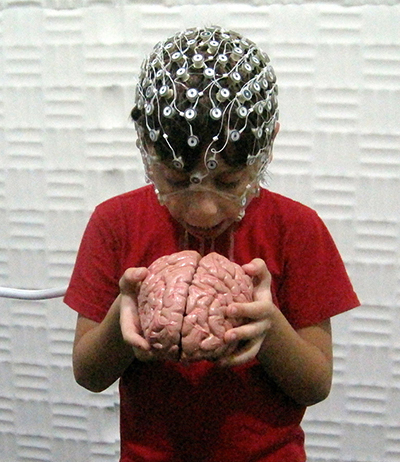
Nadey, the 8-year-old son of Reem Khamis-Dakwar, Ph.D., wears the electrodes associated with an EEG test while marveling at a model of the human brain.
As the chair-elect of the and the director of the 鈥攖he first electroencephalogram (EEG) lab at the 鈥�Reem Khamis-Dakwar, Ph.D., supervises 果酱视频 students in research projects that involve the use of EEG to better understand challenges in speech and language pathology.
In an EEG test, flat metal disks, or electrodes, with thin wires are attached to the scalp to measure electrical activity in the brain.
Dr. Khamis-Dakwar, who is also a speech-language pathologist and associate professor in the department, teaches graduate courses in neuroscience, bilingualism and communication disorders, with an emphasis on understanding brain functioning related to observed speech and language behaviors.
Graduate students and in the and former grad student , have used the NSLP Lab to work on research projects that Dr. Khamis-Dakwar calls 鈥渦nique and very important in the development of our field.鈥�
Dr. Hoffman, now a visiting professor at the Stony Brook University, studied the effect of insulin treatment on the vocabulary skills of children with diabetes. Dr. Khamis-Dakwar supervised his dissertation.
Zambriski is researching the impact of different approaches to reading rhyming books on children鈥檚 awareness development to rhymes.
Jimenez-Harrison鈥檚 study concerns how African-American children who communicate at home in colloquial 鈥渂lack English鈥� process Standard English when they hear it versus when they read it.
Zambriski and Jimenez-Harrison traveled to Eugene, Oregon鈥攁t 果酱视频鈥檚 expense鈥攖o acquire EEG skills certification at .
Jimenez-Harrison鈥檚 project is inspired by Dr. Khamis-Dakwar鈥檚 research into the Arabic diglossia in her hometown of . (A diglossia refers to the presence of two varieties of the same language within one community鈥搊ne acquired naturally and used mainly in daily communication, and the other learned in schools and used in formal communication.)
Dr. Khamis-Dakwar, a Palestinian citizen of Israel, earned bachelor鈥檚 and master鈥檚 degrees at Tel Aviv University before receiving a through , an American nonprofit organization, to Teachers College, Columbia University, in 2003.
鈥淢y academic experience in the U.S. has been very fulfilling. Our original plan was to stay in the country a few years, but we鈥檝e been here ever since,鈥� said Dr. Khamis-Dakwar, who has an and lives in Manhattan with her husband, Jamil, who heads the human rights program at the , and their sons Fouad, 14, and Nadey, 8.
Dr. Khamis-Dakwar received her Ph.D. in 2007 from Columbia, where she continues to collaborate on research projects with Karen Froud, Ph.D., her former professor, while training future speech-language pathologists at 果酱视频.
For further information, please contact:
Todd Wilson
Strategic Communications Director听
p 鈥� 516.237.8634
e 鈥� twilson@adelphi.edu