果酱视频 alumnus Stephen Demos '83, reminisces about language learning at 果酱视频 and the advancements the Department of Languages, Literatures and Cultures has made.
The virtual global village is a relatively new phenomenon. The average person had little or no direct interaction with individual events across the continental divide just some thirty years ago. Prior to the advent of the Internet, one was not able to instantaneously 鈥渢ext message鈥� or 鈥渟end email鈥� with the touch of a button. Thirty years ago, in fact, a 鈥渢weet鈥� was exclusively the sound made by a bird, 鈥渂rowsing鈥� was an activity reserved for the aisles of a department store, and 鈥渃hat room鈥� was the corner caf茅. The wealth of online news agencies that now exist had a corresponding paper-based medium, but were limited to geographical constraints and the logistics of international distribution. We did not enjoy the advantages of instant access to world events, the global family or an almost infinite corpus of information via the miracle of Cyberspace.
 The very absence of personal computers, smart phones, educational software, search engines and social media posed a unique challenge to those endeavoring to cross the language barrier. The foreign language students faced a particularly formidable task prior to the Internet Revolution. Most of us started to learn a language knowing very little about the cultural and socio-political context in which the particular language was spoken. The grammar and conversation books were little help in this regard. Moreover, those books sometimes lacked cultural sensitivity, portraying stereotypical images with insulting practice phrases, such as 鈥淭hat foolish servant has not carried out your order鈥� (Satyanarayana and Avadhanandan, Hindi English Self-Instructor [Madras: Hindi Prachar Press, 1961], 176). And, 鈥淭his book [鈥 will not help a man talk to a crossing-sweeper the day of his arrival but it will quicken his progress in talking after the first month or so鈥� (A.S. Tritton, Arabic [New York: David McKay, 1977], ix). The opportunities for immersion were also quite limited. For example, despite a large New York Latino population, there were only two Spanish language television stations, both based in New Jersey鈥斺�淐anal 47鈥� and 鈥淐anal 41鈥�. The two stations offered only a half hour of news each evening for Spanish speakers from South America, Central America, the Caribbean and Europe! The situation for speakers of other foreign languages was even more dire.
The foreign language student depended entirely upon a book and a vinyl long-playing record, if it existed for the particular foreign language. There were no interactive DVDs that allowed the student to hear native pronunciation. Instead, the language grammar or conversation book only offered technical explanations of correct pronunciation, such as,
鈥渋s the voiced correlative of pronounced with more tightening of the throat and forcing up of the larynx, producing a metallic, rather low-pitched voice, they will near to Arabic vowels in the neighborhood of this consonant.鈥� (Tritton, Arabic, 17)
There were rare instances when a vinyl record was available through a coupon in the back of the book. The student would mail the coupon via the U.S. Postal Service and then wait six to eight weeks for a reply. Sometimes the record never arrived!
This was not a very practical approach to language learning, and the foreign language student yearned for a reliable source of instructional aids. The was, even at that time, an outstanding center of language learning. The unparalleled quality of instruction and exemplary level of dedication shown by its staff created an oasis for the language student. A variety of courses in grammar, conversation, literature and history gave the student a well-rounded and enriched perspective of not only the language but also its people. 果酱视频 further responded to the growing needs of its foreign language students by establishing a 鈥渓anguage laboratory.鈥� The was indeed leading edge for its time. It had multimedia equipment to record radio and television and to show foreign language films. The lab had equipment to help students improve their pronunciation and strive for a native accent. There was a cassette tape recorder at each desk for this purpose. The student would first listen to the recording of a text being read by a native speaker, and then record his or her voice reading the same text. The student would finally play back their own reading in order to compare pronunciation and eliminate deficiencies.
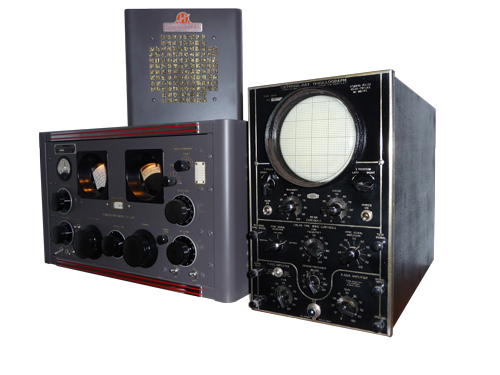
The language lab also made foreign news available from another source. Prior to the Internet Age, live communication from faraway places was only possible via shortwave radio. Positioned to the right of the desk of the lab coordinator was a top-of-the-line Hammarlund SP-600 multi-band radio receiver. This high-end receiver enabled students and professors alike to follow events throughout Latin America and the Middle East. I personally remember Dr. Warren Bratter assisted by language lab coordinator Ellen Andrasick, regularly recording broadcasts. We were able to keep abreast of news from Nicaragua in the days following the fall of the Somoza regime, and the activities of the FMLN in neighboring Salvador.The ability to listen to foreign perspectives placed us within a cultural and sociopolitical context. The Department of Languages, Literatures and Cultures did not simply teach, but rather inspired. The professors encouraged critical thinking, challenged and enriched their students, making use of every available tool.
The language lab radio was manufactured by the Hammarlund Company in the year 1950 abd was employed by the US Army, Navy, CIA and FBI for covert surveillance and signal interception. This radio played an integral role in the course of U.S. History and policy. The original selling price was $1,140 which in 2012 would be equivalent to approximately $9,000! The radio still fetches approximately $3,000 at auction. This was 65 pounds of electronic circuitry sensitive enough to pick up any signal transmitted by friend or foe. It was a very technologically advanced example of engineering. It was so vital to U.S. intelligence agencies that its manual included detailed instructions on how to destroy the unit with flame throwers or incendiary grenades in order to prevent enemy use.
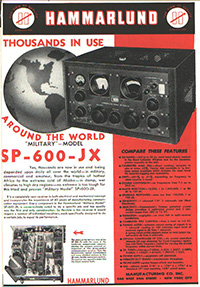 果酱视频 has always employed every available resource for the benefit of a quality education. There is a kind of nostalgia associated with the radio receiver precisely because it was the best tool available at the time. Moreover, though originally designed for wartime use, it was transformed by 果酱视频 into an instrument promoting mutual understanding. The 鈥渙ld radio鈥� is a symbol of 果酱视频鈥檚 commitment to a standard of excellence and promotion of cultural exchange. The 鈥渙ld radio鈥� is still in use today in my home study鈥攊t continues its flawless service for well over half a century.
The Department of Languages, Literatures and Cultures at 果酱视频 similarly continues its commitment to facilitating international relations via constructive dialogue. The Department of Languages, Literatures and Cultures has as its objective the building of a global community founded upon progressive ideas and mutually beneficial action. The Language Resource Center is the next step in building towards such ideals, and its students are invited to envision a society not defined by conflict and aggression, but rather a spirit of cooperation and mutual advancement.
For further information, please contact:
Todd Wilson
Strategic Communications Director听
p 鈥� 516.237.8634
e 鈥� twilson@adelphi.edu