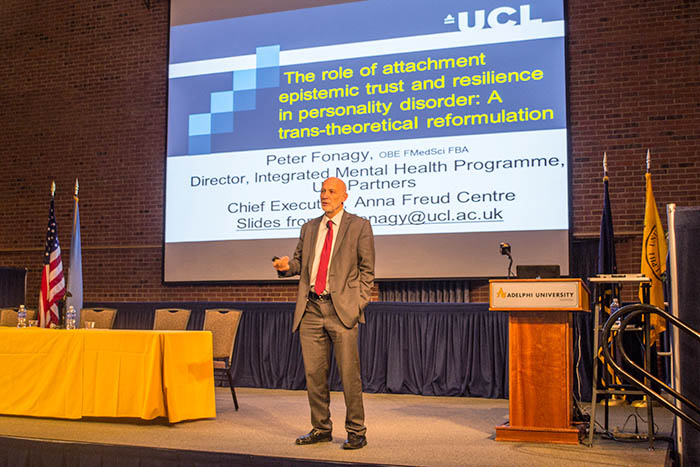
Renowned psychologist Peter Fonagy, Ph.D., gives a lecture and a workshop for 果酱视频's Derner Institute.
by Lauren Knopf
Peter Fonagy, Ph.D., the Freud Memorial Professor of Psychoanalysis at University College London and chief executive of the Anna Freud Centre, presented his lecture, 鈥淭he Role of Attachment, Epistemic Trust and Resilience in Personality Disorder: A Trans-Theoretical Reformulation,鈥� to an audience of students, faculty and alumni of the . The lecture was part of 果酱视频鈥檚 Celebration Gordon F. Derner鈥檚 Life and Legacy on November 13, 2015, and was followed the next day by a workshop on Mentalization Based Treatment (MBT) for Borderline Personality Disorder (BPD), led by Dr. Fonagy.
Dr. Fonagy and his close collaborator Anthony Bateman, Ph.D., coined the term mentalization to capture a core human capacity that is frequently disrupted in individuals suffering from BPD. When we mentalize, we seek to understand ourselves and others in terms of our mental activity鈥攖houghts, wishes, beliefs and intentions鈥攔ather than our observable behavior. An important function of our relationships with caregivers, known as attachment relationships, is fostering the ability to mentalize. Poor attachment relationships, as well as biological factors such as temperament, may create vulnerability to BPD by interfering with the motivation and skills to explore one鈥檚 own and others鈥� minds.
Without adequate mentalization skills, individuals with BPD struggle to develop a stable and coherent identity and are liable to misinterpret social and emotional cues from others. This creates a sense of social disconnection that is, Dr. Fonagy contends, 鈥渢he most intense experience of pain of any mental disorder we know.鈥� The pain is uniquely intense because the capacities that are compromised in BPD are those most closely linked with human survival: attachment, mentalization, and epistemic trust, which is the ability to relax our natural vigilance to threats in order to learn vital information about the world from trusted others. The fundamental question for people with BPD, Dr. Fonagy noted, is 鈥淲ho can I trust to learn from?鈥�
The singular goal of MBT, an empirically validated treatment for BPD developed by Drs. Fonagy and Bateman, is to restore mentalizing whenever it is absent. A major obstacle to this goal is the therapy itself, insofar as the therapeutic relationship stimulates the patient鈥檚 fears that he will be criticized, rejected and abandoned. 鈥淢entalization stops when attachment is activated,鈥� Dr. Fonagy explained. 鈥淲hen you feel intensely about another person, you cannot evaluate their social trustworthiness.鈥� Signs that a patient has stopped mentalizing include inappropriate certainty about another person鈥檚 state of mind; excessive reliance on external evidence, such as facial expressions and behavior, to deduce internal states; and expressions of emotional distress that overwhelm cognitions.
Through a series of role play scenarios, Dr. Fonagy demonstrated and workshop participants had the opportunity to practice the techniques that comprise MBT. First, the therapist empathically validates the patient鈥檚 interpretation of and feelings about a given incident. Second, the therapist adopts a 鈥渘ot knowing鈥� stance and expresses curiosity about the incident, modeling comfort with uncertainty for the patient. Next, the therapist might employ 鈥渃ontrary moves鈥� to replace the patient鈥檚 one-sidedness with more balanced thinking, for example encouraging focus on the self if the patient is overly focused on another person, or drawing attention to affective states when the patient appears dissociated from emotion.
Although MBT is a manualized treatment, Dr. Fonagy emphasized that techniques for enhancing mentalization may be incorporated as a part of any therapeutic modality, including psychodynamic and cognitive-behavioral approaches. In fact, he acknowledged, MBT strategies are akin to much of the work done by psychotherapists of all orientations. 鈥淭o my mind,鈥� Dr. Fonagy concluded, 鈥渢he critical issue is, whatever you鈥檙e practicing, doing a little bit more mentalizing can鈥檛 do any harm.鈥�
Lauren Knopf is a clinical psychology听doctoral candidate at the Derner Institute.听
For further information, please contact:
Todd Wilson
Strategic Communications Director听
p 鈥� 516.237.8634
e 鈥� twilson@adelphi.edu