Believes that healthcare in Haiti will only improve with a strong nursing infrastructure.
By Ela Schwartz
“People in Haiti are in need, but they are also ready to learn. They want things toÌýchange.â€�—Dr. Wladimir Louis-Charles, B.S.N. ’12Healing Haiti
Dr. Wladimir Louis-Charles, B.S.N. ’12, was not in Haiti on January 12, 2010, theÌýday a magnitude-7 earthquake devastated his homeland. He was in the neighboring Dominican Republic, presenting his research at a bioethics conference. As soon as theÌýnews hit, he and other volunteers jumped into action, making the five-hour trek acrossÌýthe border and into Port-au-Prince. There they found unimaginable devastation:Ìýthe capitol building collapsed, multistory concrete buildings pancaked to the ground, theÌýstreets filled with thousands of people in dire need of medical help.
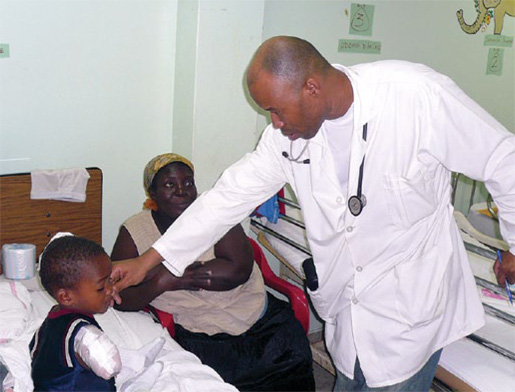 Dr. Wladimir Louis-Charles ’12 administers to a young amputee patient. |
Dr. Louis-Charles’ next 21 days consisted of nonstop triage on what he estimates to beÌý5,000 patients—setting broken bones so limbs could heal and amputating them whenÌýthe damage was too severe, trying to treat spinal injuries and sometimes informingÌýpeople that they would never walk again. By night, he helped unload trucks stocked withÌýmedical supplies, food and water and, later, wheelchairs and walkers.
While he credits the international rescue workers and doctors who came to the scene,ÌýDr. Louis-Charles realized that relying on foreign aid organizations is akin to applyingÌýa Band-Aid to a lethal wound. “We don’t need people to come to Haiti and then leave,â€�Ìýhe says. With student visas difficult to obtain and Haitian nurses likely to remain inÌýthe States after experiencing life here, the solution was to create a school in HaitiÌýto train nurses to provide for the long-term healthcare needs of survivors as well asÌýphysical and occupational therapists to teach people how to regain independence andÌýemployment and psychologists to help them overcome their emotional trauma and findÌýthe strength to carry on.
“People in Haiti are in need, but they are also ready to learn. They want things toÌýchange,â€� he says.
Dr. Louis-Charles had wanted to pursue a career in medicine since his belovedÌýgrandfather had suffered from a brain aneurysm. “He said he was OK and not to callÌý911,â€� Dr. Louis-Charles says. “But he only lived another 15 days. I felt that perhaps weÌýcould have saved him if I’d known how to help.â€� Dr. Louis-Charles attended NassauÌýCommunity College and then went on to receive his medical degree from the InstitutoÌýTecnológico de Santo Domingo. He planned a future as a practicing physician, but afterÌýthe earthquake felt compelled to help his country. “It’s what my grandparents wouldÌýhave wanted me to do,â€� he says.
To be a nurse educator, he would need to become a nurse himself. When he told hisÌýsister Michaelle Louis-Charles, B.S.N. ’07, his goal, “She told me she’d received aÌýbrochure about the PATH program and said, ‘We have to go to ¹û½´ÊÓƵ to speak to Dr.Ìý[Janet] Raman.’â€�
Dr. Louis-Charles became part of the first cohort of ¹û½´ÊÓƵ’s program (formerly called PATH), which enables careerÌýchangers to obtain a B.S.N. after 14 months of full-time study.ÌýDespite his extensive classroom and field experience, he found nursing to be aÌýchallenge. “As a physician, you’re trained to diagnose, but as a nurse, the emphasis isÌýon clinical thinking and treating the whole person,â€� he says.
Always a strong student, Dr. Louis-Charles was disappointed with his grades. A coupleÌýof months into the program, he went to the office of Dr. Helen Ballestas, assistantÌýprofessor of nursing. “I told her this wasn’t for me and startedâ€� to get teary-eyed. “SheÌýgave me a hug and encouraged me to continue. All the faculty here have been veryÌýencouraging.â€�
After his graduation in August 2012, Dr. Louis-Charles returned to a building in theÌýnorth of Haiti where classes have been in session; in between studying, he managed toÌýrecruit 22 students for his school. “I translate course materials from English into French,ÌýSpanish and Creole and share the knowledge with them,â€� he says. “We will also teachÌýthem English and programs like PowerPoint. I want our nurses in Haiti to be at the sameÌýlevel as Americans and Europeans.â€� He hopes to bring ¹û½´ÊÓƵ students and facultyÌýback to Haiti to share their knowledge and gain valuable experience.
Assistant Professor Andrea McCrink, director of the accelerated program, agrees thatÌýhealthcare in Haiti will only improve with a strong nursing infrastructure. Hardly aÌýstranger to practicing in a developing country, she says she is exploring how theÌý¹û½´ÊÓƵ School of Nursing can participate in Dr. Louis-Charles’ project. “Wladimir has aÌýsense of dedication about him,â€� she says. “He has a mission. He has had a journey andÌýhe has struggled at times. And we are so very proud of him.â€�
For further information, please contact:
Todd Wilson
Strategic Communications DirectorÌý
p – 516.237.8634
e – twilson@adelphi.edu